


Why Paint Finishes Look Better on One-Piece MDF Doors
Paint Doesn’t Hide Problems — It Reveals Them
Every cabinet shop has seen it.
A door looks fine raw. It sands well. Primer goes on smoothly. Then weeks or months later, the phone rings:
“I can see lines in the paint.”
“The shaker looks soft now.”
“Why does this door look different than the others?”
Paint doesn’t hide imperfections — it magnifies them. And when paint fails visually, the root cause is almost always door construction, not the coating.
For painted cabinetry, one-piece MDF doors consistently produce better-looking, longer-lasting finishes than multi-piece doors. This isn’t opinion or marketing — it’s physics, material behavior, and machining quality.
This article explains why paint finishes look better on one-piece MDF doors, what actually goes wrong with other constructions, and why more professional cabinet shops are making the switch.

Paint Is Unforgiving — Especially on Cabinet Doors
Painted cabinet doors demand:
Perfect surface continuity
Stable substrates
Clean, sharp profiles
Minimal movement over time
Even premium coatings cannot compensate for:
Joint movement
Inconsistent absorption
Fiber tear-out
Soft or crushed edges
If the substrate moves, the paint will show it. If the surface isn’t uniform, the finish will telegraph it.
This is where one-piece MDF doors have a structural advantage.
What Makes One-Piece MDF Doors Different?
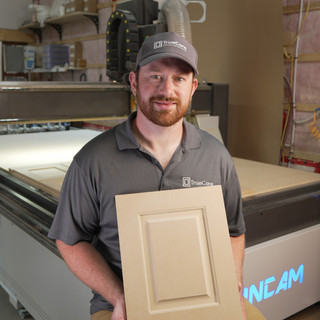
A one-piece MDF door is CNC-machined from a single solid panel of MDF. The frame, panel, and profile are all cut from the same piece — no joints, no glue-ups, no mechanical connections.
That single decision changes everything about how paint behaves.
Key Difference:
The entire door expands, contracts, absorbs, and cures as one unit.
Paint loves consistency.
Why Multi-Piece Doors Struggle Under Paint
Before explaining why one-piece MDF doors excel, it’s important to understand why traditional doors fail visually.
1. Joints Are the Enemy of Paint
In 5-piece doors, even when MDF is used:
Rails and stiles are separate components
Glue joints are under constant stress
Seasonal movement concentrates at seams
Paint films are rigid once cured. When joints move — even microscopically — paint cracks, sinks, or reveals lines.
This is called joint telegraphing, and it is the number one complaint with painted cabinet doors.
One-piece MDF doors eliminate joints entirely.
2. Different Parts Absorb Paint Differently
Even with MDF components:
End grain absorbs more primer
Flat faces absorb less
Profiles absorb inconsistently
This leads to:
Uneven sheen
Shadowing around profiles
Subtle texture differences
On a one-piece MDF door, absorption is uniform across the entire surface, which allows primer and topcoats to cure evenly.
3. Profiles Lose Definition Over Time
On assembled doors:
Movement softens profile edges
Sanding to hide joints rounds corners
Paint build-up fills sharp details
The result:
Shakers that look dull
Details that disappear
Doors that lose their “factory” look
Paint doesn’t just show defects — it amplifies softness.
Why One-Piece MDF Doors Produce Better Paint Finishes
Now let’s break down the specific reasons paint finishes consistently look better on one-piece MDF doors.
1. Seamless Surface = Seamless Finish
Paint loves continuity.
Because one-piece MDF doors have:
No joints
No seams
No glue lines
Paint lays down as a continuous film, rather than bridging multiple components.
This means:
No visible lines months later
No cracking at corners
No sinking at rail intersections
For painted cabinetry, this alone is a massive advantage.
2. Uniform Density = Uniform Paint Absorption
Premium MDF has a consistent fiber structure. When the door is one piece:
Primer absorption is even
Topcoats cure uniformly
Sheen remains consistent
This produces:
Richer color
Smoother appearance
More predictable results
On cheap or assembled doors, painters often chase absorption problems with extra coats — which increases time, cost, and risk.
3. CNC-Cut Profiles Stay Sharp After Finishing
One-piece MDF doors are CNC-machined in a single operation. When done properly:
Profiles are symmetrical
Corners are crisp
Depth is consistent
Because there’s no joint movement:
Profiles don’t soften over time
Edges don’t round prematurely
The door still looks sharp years later
Paint enhances sharp geometry — but only if it’s there to begin with.
4. No Glue = No Ghosting
Glue lines are silent finish killers.
Even when invisible raw, glue joints can:
React differently to moisture
Cure differently under paint
Shift under seasonal stress
This leads to:
“Ghost lines” under paint
Subtle texture changes
Callbacks that are hard to explain
One-piece MDF doors remove glue from the equation entirely.
5. Better Sanding Outcomes With Less Effort
Quality one-piece MDF doors:
Require minimal sanding
Maintain profile definition
Don’t need aggressive edge prep
This matters because:
Over-sanding softens details
Rounded edges look cheap under paint
Inconsistent sanding shows through high-gloss finishes
Good machining reduces sanding — and preserves the design.
Why CNC Quality Matters for Paint Results
Not all one-piece MDF doors are equal.
The CNC process determines how paint will ultimately look.
Poor CNC Machining Causes:
Fiber tear-out
Crushed edges
Fuzzy profiles
Rounded inside corners
These defects absorb paint unevenly and require excessive sanding, which degrades the door further.
High-End CNC Machining Delivers:
Clean fiber cuts
Sharp profile transitions
Smooth surfaces ready for primer
Paint finishes don’t improve bad machining — they expose it.
The Role of Tooling in Paint Quality
Tooling quality is often overlooked, but it directly affects finish results.
Cheap Tooling:
Tears MDF fibers
Burns edges
Creates micro-fraying
Premium Tooling (PCD):
Cuts fibers cleanly
Produces crisp edges
Maintains consistency over long runs
This is why CNC MDF doors cut with PCD diamond tooling consistently finish better — especially on light or high-sheen paints.
Canadian Climate Makes This Even More Important
In Canada, painted cabinetry faces:
Dry winters
Humid summers
Rapid seasonal changes
Multi-piece doors experience:
Differential movement
Joint stress
Finish cracking over time
One-piece MDF doors:
Move as a single unit
Reduce stress points
Maintain finish integrity longer
Paint failures often appear months later — right when clients least expect them.
Why Painters and Finishers Prefer One-Piece MDF Doors
Professional finishers consistently report that one-piece MDF doors:
Prime faster
Sand cleaner
Spray more evenly
Cure more predictably
This leads to:
Faster throughput
Fewer defects
Higher-end final appearance
The door becomes an asset — not a variable.
How TrueCore Designs Doors for Paint First
At TrueCore, one-piece MDF doors are engineered specifically for paint performance.
Our Approach:
Premium MDF selected for CNC machining
Door profiles designed to hold paint cleanly
Industrial CNC routers for consistency
PCD diamond tooling for edge integrity
Tight quality control before doors leave the shop
The goal isn’t just a nice raw door — it’s a door that looks exceptional after paint and stays that way.
When One-Piece MDF Doors Make the Most Sense
One-piece MDF doors are ideal for:
Painted cabinetry
Refacing projects
Modern and transitional styles
Shops prioritizing consistency and speed
They may not replace every door type — but for paint, they are often the superior choice.
Final Takeaway: Paint Rewards Good Construction
Paint doesn’t forgive shortcuts.
If your finishes:
Look inconsistent
Develop lines over time
Lose sharpness
The issue likely isn’t your coating — it’s the door.
One-piece MDF doors provide the most stable, consistent substrate for painted cabinet finishes.
Ready to See the Difference?
If you want painted cabinet doors that:
Finish cleaner
Stay sharper
Reduce callbacks
👉 Request samples from TrueCore👉 Get an instant quote through our online ordering form
Built for shops that care about how the final product actually looks.


Comments