


Why You Should Never Edge Band MDF Cabinet Doors
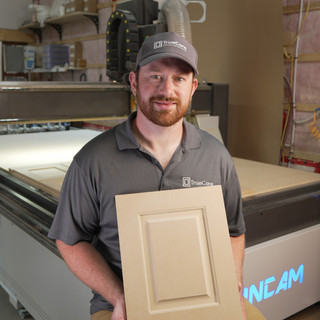
Edge banding MDF cabinet doors has become increasingly common—but that doesn’t mean it’s the right solution.
In fact, edge banding is often used to mask deeper problems in material quality and machining. It adds cost, introduces new failure points, and ultimately works against the goal of producing long-lasting, high-quality painted cabinet doors.
This article explains why MDF doors should never be edge banded, what problems edge banding actually creates, and how using proper MDF, tooling, sanding, and primer eliminates the need for it entirely.

Edge Banding Is a Patch, Not a Solution
The core reason MDF doors are edge banded is simple:
The MDF underneath isn’t good enough to finish properly.
Low-grade MDF:
Tears during machining
Sands poorly
Has weak, fuzzy edges
Absorbs primer inconsistently
Instead of fixing those root issues, some manufacturers apply edge banding to “seal” the edges and make the door look finished.
That may work temporarily—but it introduces far more problems than it solves.
Edge Banding Creates a Major Failure Point
Edge banding adds a mechanical and adhesive joint around the perimeter of the door. That joint is exposed to:
Heat
Steam
Moisture
Daily handling
Seasonal expansion and contraction
In real kitchens—especially near dishwashers, kettles, ovens, and sinks—edge banding can and does fail.
Common issues include:
Banding lifting or peeling
Corners separating
Visible seams under paint
Glue lines telegraphing over time
Once edge banding starts to fail, it’s not repairable in a clean or permanent way. The entire door is compromised.
Steam and Heat Are the Real Enemies
Painted MDF doors are often installed in environments with:
Steam from dishwashers
Heat from ovens and ranges
Rapid temperature changes
Edge banding adhesives are not immune to these conditions.
Over time:
Adhesives soften
Bond strength weakens
The band begins to release
This is why edge banding on MDF doors near sinks and dishwashers is especially problematic.
Edge Banding Makes Paint Finishes Worse — Not Better
From a finishing standpoint, edge banding is counterproductive.
Problems include:
Different materials meeting at the edge (banding + MDF)
Different expansion rates
Different paint absorption characteristics
This leads to:
Visible edge lines under paint
Inconsistent sheen
Cracking or ghosting over time
Paint wants a uniform substrate. Edge banding destroys that uniformity.
Why Some Manufacturers Edge Band MDF Doors
Edge banding MDF doors usually signals one or more of the following:
Lower-grade MDF
Poor CNC tooling
Torn or fuzzy edges
Inadequate sanding
Weak primer systems
Instead of addressing these issues directly, edge banding is used as a workaround.
But workarounds always show up later.
The Real Solution: Proper MDF, Tooling, and Finishing
High-quality MDF doors do not need edge banding.
When the fundamentals are done correctly, raw MDF edges finish beautifully.
That requires:
1. Premium MDF
High-density, consistent MDF:
Machines cleanly
Sands evenly
Holds crisp profiles
Absorbs primer uniformly
Cheap MDF is the root cause—not exposed edges.
2. Proper CNC Tooling
Clean edges start at the machine.
With:
Correct feeds and speeds
Sharp, high-quality tooling (PCD where appropriate)
MDF fibers are cut cleanly, not torn.
That alone eliminates many edge problems.
3. Correct Sanding (Up to 320 Grit)
Proper sanding:
Tightens MDF fibers
Refines edges
Preserves profile geometry
Over-sanding or skipping grits causes more harm than good. Controlled sanding is key.
4. High-Build, Professional Primer
A quality high-build primer:
Seals MDF edges properly
Fills micro-porosity
Creates a uniform surface
When applied correctly, the edge becomes just as durable and smooth as the face.
No banding required.
Edge Banding Adds Cost Without Adding Value
Edge banding:
Adds material cost
Adds labour
Adds complexity
Adds failure points
And for painted MDF doors, it adds zero long-term benefit.
Worse, when it fails, it reflects poorly on the cabinet shop—not the door supplier.
One-Piece MDF Doors Should Never Be Edge Banded
Edge banding makes even less sense on one-piece MDF doors.
One-piece doors are specifically designed to:
Eliminate joints
Reduce failure points
Finish as a single, uniform surface
Adding edge banding re-introduces the very problems one-piece construction is meant to solve.
How TrueCore Approaches MDF Door Edges
At TrueCore, MDF doors are never edge banded.
Instead, we focus on:
Premium MDF selection
CNC machining with clean edge integrity
Proper sanding standards
Professional, high-build primers
Our edges are designed to be:
Painted directly
Durable long-term
Stable in Canadian kitchens
We solve the real problem—rather than covering it up.
Final Thoughts: Fix the Cause, Not the Symptom
Edge banding MDF cabinet doors is a reaction to poor materials and processes.
It doesn’t improve durability. It doesn’t improve finish quality. And it absolutely does not improve long-term performance.
If MDF edges are failing, the answer isn’t banding—it’s better MDF, better machining, better sanding, and better primer.
That’s how high-quality MDF doors have been made for years—and how they should continue to be made.
Want MDF Doors Without Edge Banding (For a Reason)?
If you’re a cabinet shop looking for MDF doors that:
Finish clean without edge banding
Hold up near heat and steam
Eliminate unnecessary failure points
👉 Get a quote through the TrueCore online ordering form👉 Request samples and inspect the edges yourself


Comments