


One-Piece MDF Cabinet Doors vs 5-Piece Doors: Which Is Better for Canadian Cabinet Shops?
Introduction: Why Cabinet Door Construction Matters More Than Ever
For cabinet shops and refacing companies across Canada, cabinet doors are no longer just a design choice — they are a performance decision. Door construction directly affects finish quality, warranty claims, lead times, production efficiency, and long-term customer satisfaction.
For decades, the industry defaulted to 5-piece cabinet doors: rails, stiles, and a center panel assembled with glue and joinery. But with the rise of CNC technology, premium MDF materials, and advanced tooling, a strong shift is happening toward one-piece MDF cabinet doors.
Canadian shops in particular face unique challenges:
Extreme seasonal humidity swings
Dry winters and humid summers
Tight project timelines
Customers expecting flawless painted finishes
In this article, we’ll break down the real, practical differences between one-piece MDF cabinet doors and 5-piece doors, specifically through the lens of Canadian cabinet manufacturing and refacing.

What Are One-Piece MDF Cabinet Doors?
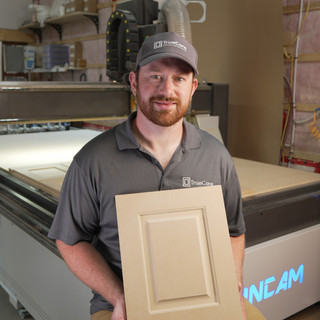
One-piece MDF cabinet doors are machined from a single solid panel of medium-density fiberboard using CNC routers. Instead of assembling rails and stiles, the entire door profile — frame, panel, and details — is cut directly into one piece.
Key Characteristics of One-Piece MDF Doors
CNC-cut from a single sheet of MDF
No joints, seams, or glue lines
Consistent profile depth and geometry
Ideal for painted finishes
Extremely stable in controlled thickness
Modern CNC machining allows for:
Shaker profiles
Slim shaker designs
Bevels, steps, and decorative edges
Custom and repeatable door styles
Because there are no mechanical joints, one-piece MDF doors eliminate many of the failure points common in traditional door construction.
What Are 5-Piece Cabinet Doors?
5-piece cabinet doors are made from:
2 stiles
2 rails
1 center panel
These components are machined separately and then assembled using cope-and-stick joinery, dowels, or tenons, followed by glue and clamping.
Key Characteristics of 5-Piece Doors
Multiple components assembled into one door
Commonly made from MDF, HDF, or solid wood frames
Traditional construction method
Widely used for painted shaker doors
While 5-piece doors can look great when new, their long-term performance depends heavily on material quality, glue integrity, humidity control, and finishing techniques.
Side-by-Side Comparison: One-Piece MDF vs 5-Piece Doors
1. Structural Stability
One-Piece MDF Doors
No joints to expand or contract independently
Uniform density across the entire door
Excellent resistance to seasonal movement
Minimal risk of joint telegraphing
5-Piece Doors
Rails and stiles can move at different rates
Glue joints are stressed by humidity changes
Higher risk of cracks at seams over time
Seasonal movement is amplified in Canada
Winner: One-Piece MDF Doors
2. Finish Quality (Critical for Painted Cabinets)
One-Piece MDF Doors
Seamless surface — no joints to show through paint
Ideal for modern, smooth, sprayed finishes
Consistent absorption across the entire door
Easier to achieve factory-level results
5-Piece Doors
Joints can telegraph through paint after curing
Seasonal movement can reveal hairline cracks
Requires more prep, sealing, and sanding
Higher chance of callbacks
Winner: One-Piece MDF Doors (by a wide margin)
3. Failure Points & Warranty Risk
One-Piece MDF Doors
No glue joints
No mechanical joinery
Fewer variables
Lower long-term failure risk
5-Piece Doors
Glue failure at rails and stiles
Joint cracking
Panel movement inside frames
Increased warranty exposure
Winner: One-Piece MDF Doors
4. Cost Efficiency for Cabinet Shops
One-Piece MDF Doors
CNC-driven efficiency
Lower labour requirements
Fewer production steps
Predictable pricing
5-Piece Doors
More machining operations
Assembly and clamping time
Higher labour costs
More variability
Winner: One-Piece MDF Doors for production efficiency
5. Lead Times & Scalability
One-Piece MDF Doors
CNC automation allows faster throughput
Ideal for batch production
Highly scalable
Consistent repeatability
5-Piece Doors
Assembly slows production
Bottlenecks during glue-ups
Harder to scale efficiently
Winner: One-Piece MDF Doors
Canadian Climate Considerations: Why This Matters More in Canada
Canada’s climate is especially harsh on painted cabinetry:
Dry winters shrink materials
Humid summers cause expansion
Repeated cycles stress joints
This is where construction choice becomes critical.
5-piece doors are inherently vulnerable because each component reacts differently to moisture changes. Even when MDF is used for rails and stiles, glue joints remain a weak point.
One-piece MDF doors, on the other hand:
Expand and contract as a single unit
Maintain profile integrity year-round
Reduce seasonal finish failures
For Canadian cabinet shops, this translates to:
Fewer callbacks
Better long-term results
Happier clients
Why CNC-Cut One-Piece MDF Doors Are Taking Over
The shift toward CNC cabinet doors isn’t just a trend — it’s a logical evolution.
CNC Advantages:
Absolute dimensional consistency
Perfect symmetry door after door
Precision profiles impossible by hand
Repeatable results at scale
With modern CNC routers and advanced toolpaths, one-piece MDF doors now offer:
Higher quality than traditional methods
Faster production
Superior paint results
Many high-end manufacturers and refacing companies across MDF cabinet doors Canada markets are already making the switch.
How TrueCore Manufactures One-Piece MDF Cabinet Doors
At TrueCore, one-piece MDF cabinet doors are manufactured with a manufacturer-first mindset, not a job-shop approach.
Our Process Includes:
Premium Canadian-sourced MDF with consistent density
PCD (polycrystalline diamond) tooling for ultra-clean cuts
CNC machining for perfect repeatability
Tight quality control at every stage
Door styles engineered specifically for painted finishes
PCD tooling is a major differentiator:
Sharper edges
Cleaner profiles
Longer tool life
Less fiber tear-out
This allows TrueCore to deliver CNC cabinet doors that are:
Ready for finishing
Consistent from order to order
Built for Canadian conditions
When 5-Piece Doors Still Make Sense
To be fair, 5-piece doors still have their place:
Solid wood applications
Stained finishes
Traditional woodworking aesthetics
However, for painted cabinetry, refacing projects, and modern cabinet shops focused on efficiency and quality, one-piece MDF doors are often the better long-term solution.
Final Verdict: Which Is Better for Canadian Cabinet Shops?
For painted cabinet doors in Canada, the answer is clear:
One-piece MDF cabinet doors offer superior stability, finish quality, efficiency, and long-term performance compared to 5-piece doors.
They reduce:
Warranty risk
Labour costs
Lead times
Seasonal failures
And they increase:
Consistency
Scalability
Client satisfaction
Ready to Upgrade Your Cabinet Doors?
If you’re a cabinet shop, refacing company, or professional woodworker in Canada looking for reliable, CNC-cut one-piece MDF cabinet doors, TrueCore makes it easy.
👉 Get an instant quote using our online ordering form👉 Consistent quality👉 Canada-wide service👉 Built specifically for painted finishes
Start your quote today at TrueCore.ca


Comments